
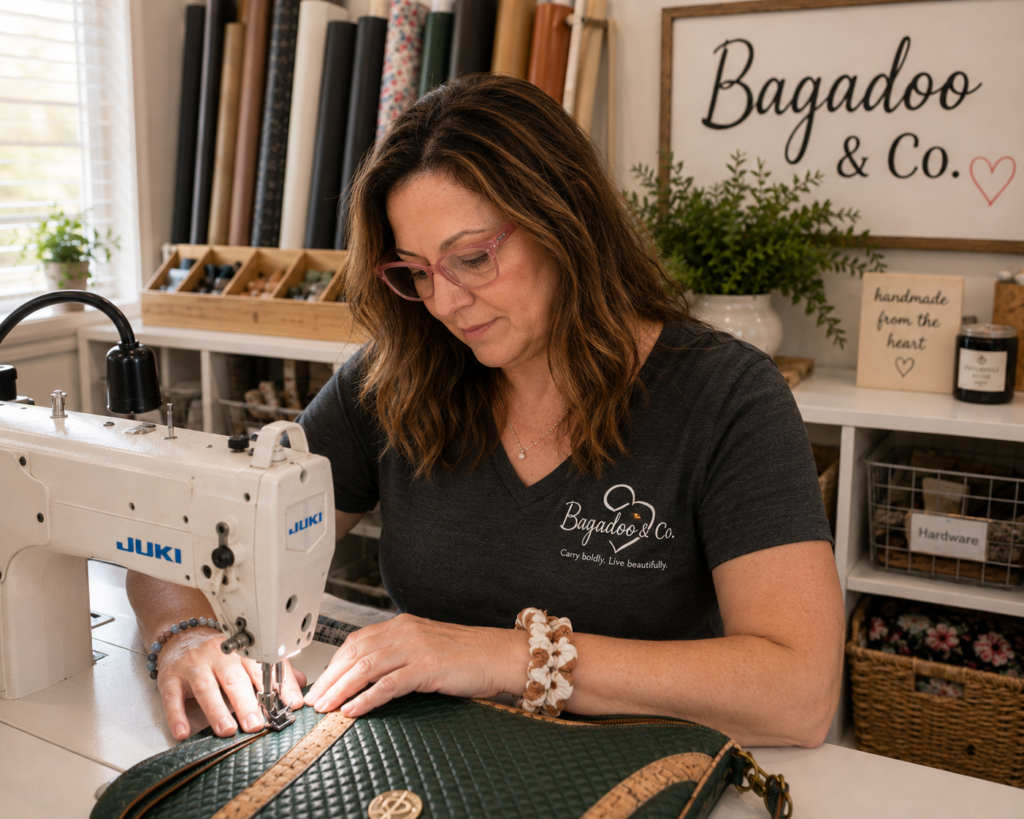
There’s something special about carrying a handmade handbag.
You can see the finished bag—the beautiful fabric, coordinating colors, polished hardware, and carefully stitched details—but what you don’t see is everything that happened before the final stitch was sewn.
A handmade handbag doesn’t begin at a sewing machine. It begins with an idea.
Before a single piece of fabric is cut, decisions are made about the pattern, materials, colors, structure, hardware, pockets, straps, and dozens of small details that ultimately determine how the finished bag will look and function.
Then comes the measuring, cutting, interfacing, preparing, sewing, assembling, trimming, turning, topstitching, and finishing.
Some steps happen quickly.
Others require patience, precision, and occasionally taking something apart and doing it again.
That process is part of what makes handmade different.
In this Behind the Seams guide, we’re taking you inside the process to see how a collection of fabric, vinyl, zippers, hardware, and other materials gradually becomes a finished handbag ready to be carried and enjoyed.
Handmade Starts Long Before the Sewing Begins
When you look at a finished handbag, it’s easy to imagine that most of the work happens at the sewing machine.
In reality, sewing is only one part of the process.
Before construction can begin, there are decisions to make.
What style of bag will it be?
How large should it be?
What materials will work best with the design?
Which colors belong together?
What hardware finish complements the fabric?
Does the bag need to be soft and flexible, or structured enough to stand on its own?
How will someone actually use it once it’s finished?
Those choices affect nearly every step that follows.
A beautiful fabric might inspire the entire bag, while another project might begin with a particular handbag style and require finding the perfect materials to bring it to life.
With a custom handbag, the process becomes even more personal because the customer’s choices become part of the design.
What makes a handmade handbag different?
One of the biggest differences is the amount of individual attention the bag receives.
Rather than moving through a large production line where different workers or machines perform individual tasks, a handmade bag is created through a much more personal process.
The maker sees the project develop from beginning to end.
That makes it possible to notice the little things: how a print is positioned, whether two materials work well together, how a pocket is aligned, or whether a piece needs to be adjusted before construction continues.
Those decisions may never be obvious when you look at the finished handbag.
But together, they’re a large part of what makes handmade feel different.
Step 1: Choosing the Right Design
Every handbag has a job to do.
A small crossbody designed for errands has very different requirements from a large travel tote. A wallet needs organization without unnecessary bulk, while a backpack needs comfortable straps and enough structure to support what it carries.
That’s why the first step isn’t simply choosing something attractive.
It’s deciding what the finished bag needs to accomplish.
A handbag design may include features such as:
- Exterior zipper or slip pockets
- Interior organization
- Adjustable crossbody straps
- Short handles
- Secure zipper closures
- Magnetic or twist-lock closures
- Card slots
- Key leashes
- Reinforced bases
- Convertible carrying options
Each feature adds function, but it also affects construction.
Even something that appears simple on the finished handbag may require several pieces and multiple construction steps behind the scenes.
Does a more complicated handbag take longer to make?
Usually, yes—but size alone doesn’t determine how complicated a bag is.
A small wallet with card slots, zipper compartments, and multiple layers may require more detailed construction than a much larger tote.
The number of pieces, pockets, zippers, hardware components, and finishing details all affect how much time and precision a project requires.
That’s one reason handmade products aren’t priced based solely on their size. A smaller item isn’t necessarily a simpler item to create.
Step 2: Choosing Materials That Work Together
This is one of the most creative parts of making a handbag—and one of the most important.
The materials need to look beautiful together, but they also need to work together.
A print might provide the personality of the bag while a coordinating solid material adds structure and balance. Hardware can quietly complement the design or become a feature of its own.
Color is only part of the decision.
The weight, thickness, texture, flexibility, and durability of each material also matter.
Depending on the handbag, materials might include:
- Cotton fabric
- Faux leather or vinyl
- Waterproof lining
- Woven interfacing
- Foam stabilizer
- Fusible fleece
- Webbing
- Zippers
- Rivets
- D-rings
- Swivel hooks
- Strap sliders
- Magnetic snaps or specialty closures
Not every handbag needs all of these.
The goal is to choose the combination that gives that particular design the right amount of structure, durability, flexibility, and personality.
Why does interfacing matter if you can’t see it?
Because some of the most important parts of a handbag are completely hidden when it’s finished.
Interfacing and stabilizers help determine how a bag behaves.
They can add strength to fabric, support pockets and closures, reinforce areas that receive extra stress, and help a handbag maintain its intended shape.
Two bags made from the same exterior fabric can feel completely different depending on what has been used underneath it.
It’s a perfect example of something customers may never see—but will experience every time they use the bag.
Step 3: Cutting and Preparing the Pieces
Once the design and materials have been chosen, it’s tempting to think it’s finally time to start sewing.
Not quite.
First, everything has to be cut and prepared.
Depending on the design, a single handbag can contain many individual pieces for the exterior, lining, pockets, gussets, straps, connectors, interfacing, stabilizer, and other components.
Each piece needs to be accurately cut because small differences at this stage can become much larger problems during assembly.
Printed fabrics add another consideration: placement.
If a fabric contains a distinctive design, simply cutting wherever the pattern piece fits may result in an important part of the print disappearing into a seam—or ending up upside down on the finished bag.
Sometimes a piece is intentionally positioned so a favorite part of the print appears prominently on the front of the handbag.
This is often called fussy cutting, and it can turn a beautiful fabric into a truly distinctive finished bag.
After cutting, pieces may need to be interfaced, stabilized, marked, or otherwise prepared before construction begins.
Zippers may need to be cut to length.
Straps and connectors need to be prepared.
Hardware needs to be organized.
By the time the first major seams are sewn, quite a bit of work has already happened.
Why is accurate cutting so important?
Handbag construction often involves multiple layers that eventually need to meet at exactly the right places.
A small cutting error can affect pocket placement, zipper alignment, seam matching, or even the final shape of the bag.
Careful preparation makes the construction process smoother and helps produce the clean, polished appearance you see in the finished handbag.
Step 4: Building the Details Before Building the Bag
One of the surprising things about handbag making is that you often don’t begin by sewing the actual handbag together.
You build the pieces of the bag first.
An exterior panel might need a zipper pocket installed.
A lining panel may need slip pockets.
A strap connector may need to be reinforced and attached.
A zipper panel may need to be assembled.
A wallet section may require card slots.
Handles may need to be constructed before they’re attached.
Each of these smaller components becomes part of the larger project later.
It’s a little like assembling a puzzle.
For quite a while, the sewing table may be covered with finished pockets, straps, panels, zipper pieces, and hardware that don’t look much like a handbag at all.
Then those individual pieces begin coming together.
And that’s when the project starts to become recognizable.
Why are some handbag features sewn so early?
Many features can’t be added once the handbag is assembled.
An interior zipper pocket, for example, is much easier—and sometimes only possible—to install while the lining panel is still flat.
The same is true for many exterior pockets, handles, connectors, and decorative details.
Handbag construction requires thinking several steps ahead because what you do now often determines what you’ll be able to do later.
That’s part of both the challenge and the satisfaction of making bags.
Step 5: Bringing the Bag Together
This is the point where all those individual pieces finally begin to look like a handbag.
Exterior panels are joined to gussets. Zipper panels are attached. Bases are constructed. Handles and strap connectors become part of the exterior. The lining begins taking shape.
And with every new seam, the project becomes a little more recognizable.
This stage can also be one of the most challenging parts of handbag construction.
Unlike sewing two flat pieces of fabric together, bag making often means working with curves, corners, thick layers, stabilizers, zippers, and hardware—all within the same project.
As the bag comes together, some areas can contain several layers of material. Careful sewing is especially important at these points because the seams need to remain strong without creating unnecessary bulk.
Why are handbags sometimes difficult to sew?
Structure is one of the biggest reasons.
A handbag needs enough strength to hold its shape and support everything carried inside it. That often means combining exterior materials, interfacing, stabilizers, lining, pockets, and reinforcement.
As those layers meet, some seams become quite thick.
Curved designs introduce another challenge because pieces with different shapes must fit together precisely.
The finished handbag may look effortless, but getting all those pieces to meet neatly can require patience, experience, and a little persuasion along the way.
Step 6: The Turning Point
There is a moment in many handbag projects that feels almost magical.
For much of the construction process, the bag may be inside out, covered in clips, surrounded by loose threads, and looking nothing like the finished product.
Then comes the turn.
Depending on the construction method, the completed exterior and lining are carefully pulled through an opening so the handbag can be turned right side out.
Suddenly, the shape appears.
The fabric you carefully positioned is on the outside.
The pockets are where they’re supposed to be.
The hardware begins to make sense.
The handbag you’ve been imagining throughout the entire process is finally sitting in front of you.
But it isn’t finished yet.
Why does a handmade bag sometimes look wrinkled when it’s first turned?
Turning a structured handbag through a relatively small opening can temporarily wrinkle or distort the materials.
Once the bag is right side out, the seams are carefully worked into position and the structure is reshaped. Depending on the materials, additional finishing may help everything settle into its intended shape.
It’s one of those behind-the-scenes moments customers rarely see.
The beautiful structured handbag in the finished photograph may have looked considerably less glamorous just a short time earlier.
Step 7: Finishing Makes the Difference
The final stages of handbag making are about refinement.
Loose threads are trimmed.
Openings are closed.
Corners and seams are shaped.
Straps are attached.
Hardware is checked.
Topstitching may be added.
The lining is settled into place.
These finishing steps can seem small compared with assembling the handbag itself, but they’re an important part of creating a polished final product.
Topstitching is a good example.
It can provide additional strength, but it also creates a clean visual finish along an edge or seam. Because it remains visible on the completed bag, there’s nowhere for uneven stitching to hide.
Hardware placement requires similar care.
A rivet positioned slightly differently on one side of a bag may be immediately noticeable when the finished handbag is viewed as a whole.
Handmade quality often lives in these little details.
What should you look for in the finishing of a handmade handbag?
Look at the handbag as a whole first, then examine the details.
Seams should feel secure. Hardware should be firmly attached. Zippers should operate smoothly. Straps and handles should feel stable, and the lining should sit comfortably inside the bag.
Handmade doesn’t mean every stitch must look as though it came from an automated factory.
It means the finished product should show care, skill, and attention to the details that affect both appearance and function.
Step 8: When Something Doesn’t Go According to Plan
Here’s something you don’t always see in photographs of handmade products:
Sometimes things go wrong.
A seam doesn’t sit quite right.
A zipper isn’t as straight as it should be.
A piece gets attached backward.
The thread breaks at exactly the wrong moment.
Or a maker reaches the end of a complicated step, looks at it, and decides:
“Nope. I can do that better.”
And out comes the seam ripper.
Mistakes and adjustments are part of making things by hand.
The difference is what happens next.
When something affects the quality of the finished handbag, the right solution is often to take the time to correct it—even when that means undoing work you’ve already completed.
Are handmade handbags supposed to be perfect?
Handmade and perfect aren’t the same thing.
A handmade item is created by a person, and very small variations are part of that process.
What matters is whether those variations affect the beauty, strength, or function of the finished product.
Good craftsmanship isn’t about pretending mistakes never happen.
It’s knowing which details matter, recognizing when something isn’t right, and being willing to fix it.
Step 9: Custom Bags Add Another Layer to the Process
A custom handbag begins with something a ready-made handbag doesn’t: your customer’s vision.
The customer may choose a favorite color, print, coordinating material, hardware finish, or other available options.
Those decisions transform an existing handbag design into something much more personal.
And sometimes the most exciting combinations are ones the maker might never have chosen independently.
That’s one of the things that makes custom work so interesting.
Two handbags created from the exact same pattern can look completely different simply because of the materials and details chosen for each one.
Does custom mean I can change everything about a handbag?
Not necessarily.
There’s an important difference between customizing a design and redesigning it.
Many custom handmade bags allow customers to choose from available fabrics, colors, hardware, and other options while keeping the underlying construction and features of the original design.
Major structural changes—such as changing dimensions, moving zippers, adding compartments, or altering the shape—can affect the entire construction process and may not always be practical.
When shopping for a custom handbag, it’s always worth asking which elements can be personalized.
Step 10: The Final Quality Check
Before a handmade handbag is truly finished, it deserves one last inspection.
This is the opportunity to look at the bag as the customer will see it rather than as the maker who’s been staring at individual pieces for hours.
Do the zippers open smoothly?
Are the pockets secure?
Does the closure work properly?
Are the straps and hardware firmly attached?
Are there loose threads?
Does the bag sit and hang as intended?
Is the interior clean?
This final check is important because the goal isn’t simply to finish making the handbag.
The goal is to create something that’s ready to become part of someone’s everyday life.
Why Handmade Takes Time
One of the most common misconceptions about handmade products is that the price primarily reflects the cost of the materials.
Materials are certainly part of it.
But you’re also paying for the work that transforms those materials into the finished product.
Think back through everything that happened before the handbag was completed:
The design was selected.
Materials were coordinated.
Fabric was carefully cut.
Interfacing and stabilizers were applied.
Pockets were constructed.
Zippers were installed.
Hardware was attached.
Individual sections were assembled.
The handbag was constructed, turned, shaped, finished, and inspected.
And that’s before considering the time spent learning the skills required to do all of those things well.
Why can handmade handbags cost more than mass-produced bags?
Mass production is designed to create enormous quantities of identical products as efficiently and inexpensively as possible.
Handmade production operates very differently.
The cost reflects not only materials but also the maker’s time, skill, equipment, experience, and the individual attention given to each piece.
That doesn’t mean handmade is automatically better simply because it’s handmade.
It means you’re purchasing something created through a fundamentally different process—and understanding that process makes it easier to understand its value.
From a Stack of Materials to a Finished Handbag
One of my favorite things about bag making is just how dramatic the transformation can be.
At the beginning, there may be nothing more than fabric, vinyl, zipper tape, hardware, interfacing, and a pattern sitting on the worktable.
None of it looks much like a handbag.
Piece by piece, that changes.
A zipper becomes a pocket.
A strip of material becomes a strap.
Flat panels gain structure.
Separate sections begin fitting together.
Eventually, all those individual components become something completely different: a functional handbag that someone can carry every day.
And in the case of a custom bag, it becomes something created specifically for the person who chose it.
That’s the part of handmade that can’t really be replicated by pulling an identical product from a warehouse shelf.
Continue Exploring the Bagadoo Blog
If you’d like to learn more about choosing and enjoying handmade handbags, continue with:
- The Ultimate Guide to Choosing the Perfect Handmade Handbag
- The Complete Guide to Buying a Handmade Handbag
- The Complete Guide to Handbag Organization Tips
- Choosing the Perfect Handmade Handbag Size
As we add more Behind the Seams articles, we’ll also explore individual parts of the making process in greater detail—from choosing materials and hardware to understanding what gives a handbag its structure.
Final Thoughts
The next time you pick up a handmade handbag, take another look at it.
Look beyond the exterior fabric.
Open the zipper.
Look inside the pockets.
Notice the hardware, the seams, the structure, and the way all the pieces come together.
Every one of those details represents a decision made somewhere along the way.
That’s what happens behind the seams.
A handmade handbag begins as a collection of completely separate materials. Through planning, skill, patience, creativity, and a lot of individual steps, those materials become something useful, beautiful, and uniquely personal.
And perhaps that’s the best part of handmade: someone didn’t simply manufacture your handbag. Someone made it.